The best battery smoke detector for bedrooms in 2026 is one that detects smoke reliably, doesn’t false-alarm from cooking or steam, and runs for 10 years without battery changes. This guide evaluates the top battery-powered detectors specifically for bedroom use, with a focus on low false-alarm rates, reliability, and ease of maintenance.
What Makes a Smoke Detector Good for Bedrooms?
Bedrooms have specific requirements that differ from hallways or basements:
Low False-Alarm Rate
Bedrooms are typically away from cooking areas, but steam from bathrooms can reach bedroom detectors. A detector with a photoelectric sensor is less prone to false alarms from steam than an ionization sensor.
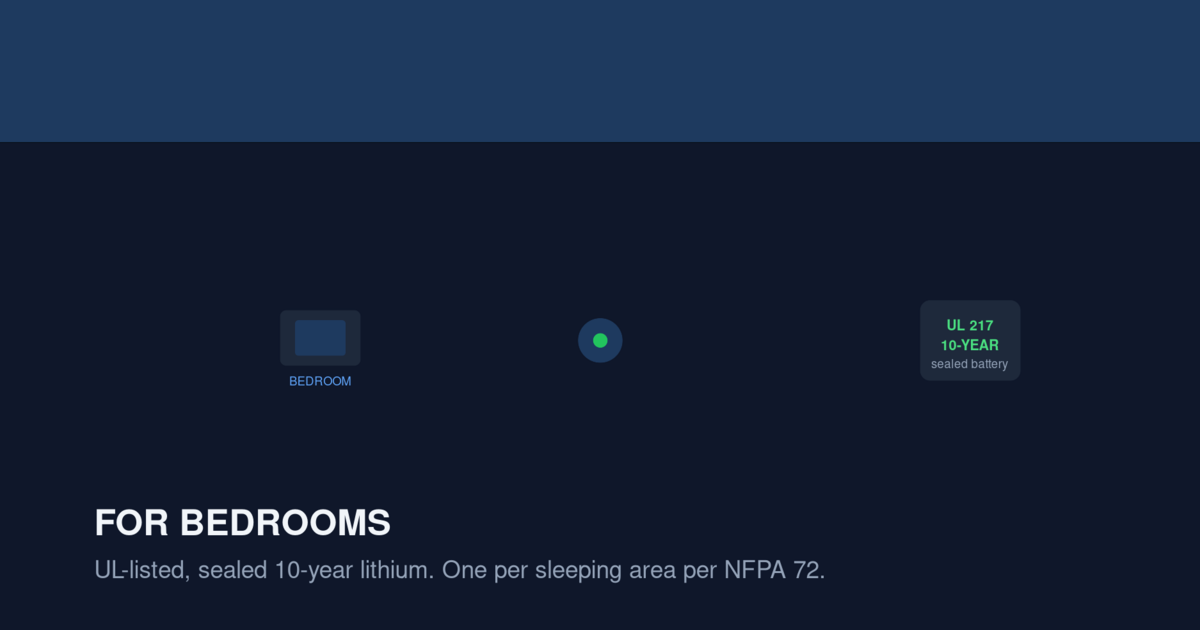
10-Year Battery Life
Bedroom detectors are often on high ceilings where battery changes are inconvenient. A 10-year sealed lithium battery eliminates the need for annual battery changes.
Quiet Operation (When Not Alarming)
A detector that chirps frequently at night disrupts sleep. Look for detectors with stable battery voltage that don’t chirp from minor temperature changes.
Voice Alerts (Optional)
Voice alerts (“Fire!” or “Low battery”) are less startling than tone alerts, especially at night. Many modern detectors include voice features.
Adequate Volume
A bedroom detector needs to be loud enough to wake sleeping occupants. The standard is 85 dB at 10 feet, which is sufficient for most bedrooms.
Our Top Picks
Here are the best battery smoke detectors for bedrooms in 2026:
Best Overall: First Alert SA3210CN10
The First Alert SA3210CN10 is a 10-year sealed lithium photoelectric detector. It has a low false-alarm rate, runs for the full detector lifespan without battery changes, and meets code in all 50 states.
Specs:
- Sensor: Photoelectric
- Battery: 10-year sealed lithium (not replaceable)
- Certifications: UL 217
- Warranty: 10 years
- Price: $30-40
Pros:
- No battery changes for 10 years
- Photoelectric sensor (low false-alarm rate)
- Test button with silence feature
- Compact design
Cons:
- No voice alerts
- No smart features
- Single sensor (smoke only, not combination smoke/CO)
Best Budget: Kidde i9050
The Kidde i9050 is a basic battery-only ionization detector. It’s the cheapest reliable detector available, but uses a 9V battery that needs annual replacement.
Specs:
- Sensor: Ionization
- Battery: 9V replaceable (1-2 year lifespan with alkaline, 5-10 years with lithium)
- Certifications: UL 217
- Warranty: 10 years
- Price: $10-15
Pros:
- Very affordable
- Reliable brand
- Easy battery replacement
- Widely available
Cons:
- Ionization sensor (higher false-alarm rate from cooking/steam)
- Annual battery replacement needed (with alkaline)
- No voice alerts
- No smart features
Best for: Rental properties, secondary homes, or budget installations.
Best Smart: First Alert SC5
The First Alert SC5 is the closest current replacement for the discontinued Nest Protect. It connects to Wi-Fi and sends alerts to your phone through the Google Home app.
Specs:
- Sensor: Split-spectrum (smoke and CO)
- Battery: 10-year sealed lithium
- Smart home: Google Home, Alexa
- Certifications: UL 217 and UL 2034
- Warranty: 10 years
- Price: $100-130
Pros:
- App alerts for smoke, CO, low battery, and end of life
- Voice alerts with location (“Smoke detected in bedroom”)
- Works with Google Home and Alexa
- Pathlight feature (motion-activated nightlight)
- 10-year battery life
Cons:
- More expensive than basic detectors
- Requires Wi-Fi
- Setup requires smartphone
Best for: Tech-savvy users who want remote alerts and smart home integration.
For full details on the SC5, see our Nest Protect Discontinued Replacement Guide.
Best Combination Smoke/CO: Kidde i9010
The Kidde i9010 is a sealed 10-year combination smoke and carbon monoxide detector with voice alerts.
Specs:
- Sensor: Photoelectric smoke + electrochemical CO
- Battery: 10-year sealed lithium
- Certifications: UL 217 and UL 2034
- Warranty: 10 years
- Price: $40-55
Pros:
- Detects both smoke and CO
- Voice alerts (“Fire!” or “Warning: carbon monoxide”)
- 10-year battery life
- No battery changes for the detector’s lifespan
Cons:
- No smart features
- More expensive than smoke-only detectors
- CO sensor expires at 10 years (same as smoke sensor in this model)
Best for: Bedrooms where you want CO detection without buying a separate CO detector.
Best Voice Alerts: First Alert P1010
The First Alert P1010 is a basic photoelectric detector with voice alerts. It uses AA batteries rather than 9V.
Specs:
- Sensor: Photoelectric
- Battery: 2 AA replaceable (1-2 years with alkaline, 5-10 with lithium)
- Certifications: UL 217
- Warranty: 10 years
- Price: $20-25
Pros:
- Voice alerts (“Fire!” or “Low battery!”)
- Photoelectric sensor (low false-alarm rate)
- AA batteries are easier to find than 9V
- Test button with silence feature
Cons:
- Annual battery replacement (with alkaline)
- No smart features
- No CO detection
Best for: Bedrooms where voice alerts are preferred over tone alerts.
Best for Large Bedrooms: X-Sense XP01
The X-Sense XP01 is a 10-year sealed lithium photoelectric detector with a loud 85 dB alarm and a compact design.
Specs:
- Sensor: Photoelectric
- Battery: 10-year sealed lithium
- Certifications: UL 217
- Warranty: 10 years
- Price: $25-35
Pros:
- Affordable 10-year sealed option
- Photoelectric sensor (low false-alarm rate)
- Test button with silence feature
- Loud alarm (85 dB)
Cons:
- No voice alerts
- No smart features
- Single sensor (smoke only)
Best for: Budget-conscious buyers who want a 10-year sealed detector without paying for smart features.
How to Choose the Right Detector
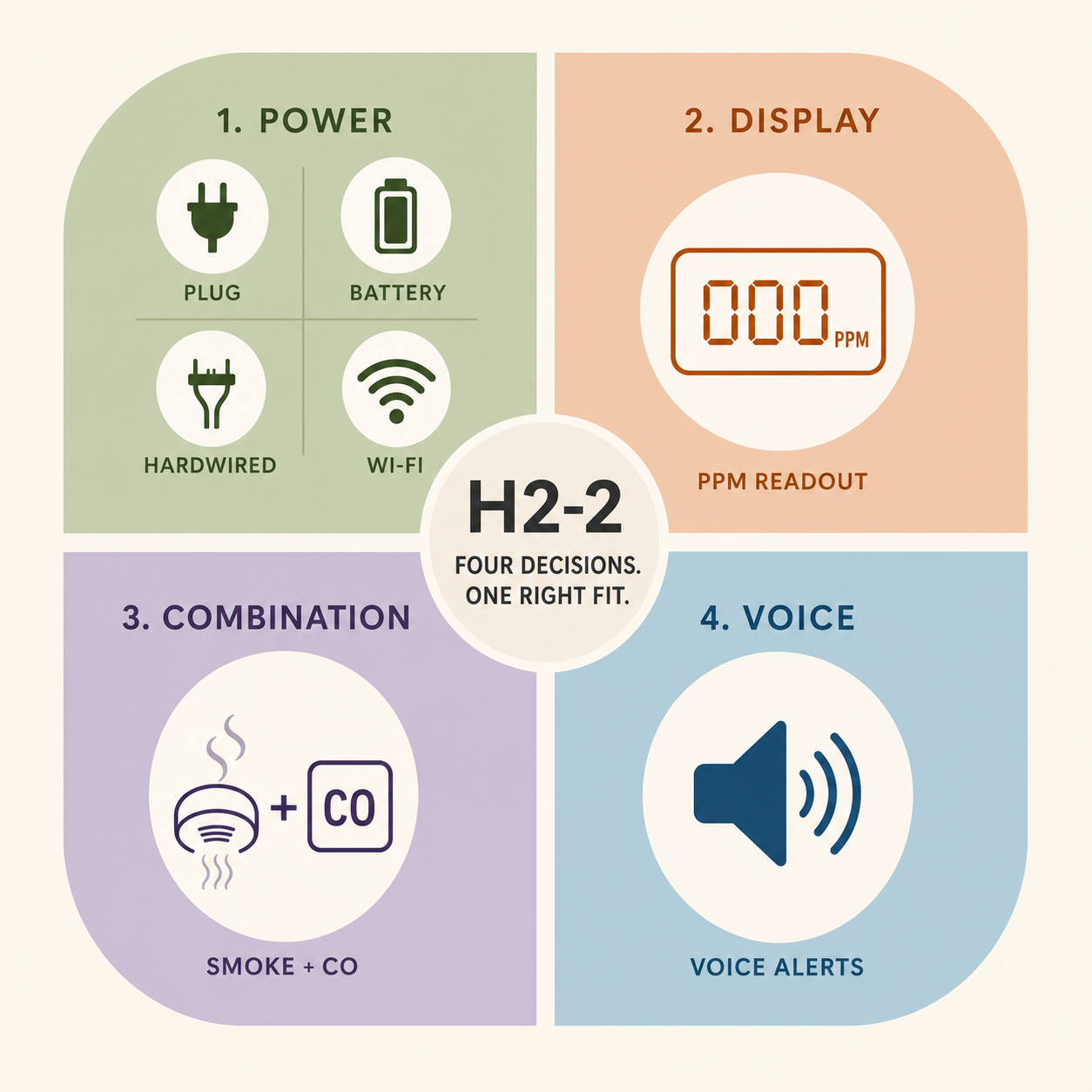
Use this decision tree to pick the right detector for your bedroom:
Step 1: Do You Need Smart Features?
Yes: Choose the First Alert SC5 or another smart detector. No: Continue to step 2.
Step 2: Do You Need CO Detection?
Yes: Choose the Kidde i9010 or another combination smoke/CO detector. No: Continue to step 3.
Step 3: What’s Your Budget?
Under $20: Choose the Kidde i9050 (basic) or X-Sense XP01 (10-year sealed). $20-50: Choose the First Alert P1010 (voice) or SA3210CN10 (10-year sealed). $50+: Choose the First Alert SC5 (smart).
Step 4: How Important Is Voice Alerts?
Very important: Choose the First Alert P1010, Kidde i9010, or First Alert SC5. Not important: Choose the First Alert SA3210CN10 or X-Sense XP01.
Comparing the Top Picks
Here’s how the top picks compare on key features:
| Feature | First Alert SA3210CN10 | Kidde i9050 | First Alert SC5 | Kidde i9010 | First Alert P1010 | X-Sense XP01 |
|---|---|---|---|---|---|---|
| Sensor type | Photoelectric | Ionization | Split-spectrum | Photoelectric | Photoelectric | Photoelectric |
| Battery | 10-year sealed | 9V replaceable | 10-year sealed | 10-year sealed | 2 AA replaceable | 10-year sealed |
| Smart features | No | No | Yes (Wi-Fi) | No | No | No |
| Voice alerts | No | No | Yes | Yes | Yes | No |
| CO detection | No | No | Yes | Yes | No | No |
| Price | $30-40 | $10-15 | $100-130 | $40-55 | $20-25 | $25-35 |
| Warranty | 10 years | 10 years | 10 years | 10 years | 10 years | 10 years |
For bedrooms specifically, the First Alert SA3210CN10 is our top pick. It combines a 10-year sealed battery (no maintenance), photoelectric sensor (low false alarms), and a reasonable price.
Installation in Bedrooms
Proper installation is just as important as choosing the right detector. Follow these guidelines:
Placement
- Mount on the ceiling, at least 4 inches from any wall
- If wall-mounting is necessary, mount 4 to 12 inches from the ceiling
- For sloped ceilings, mount within 12 inches of the peak
- Keep at least 3 feet from ceiling fans
- Keep at least 10 feet from bathroom doors (to avoid steam false alarms)
For full placement details, see our Smoke Detector Placement in US Homes guide.
Mounting
Most detectors come with a mounting bracket and screws. To install:
- Hold the bracket against the ceiling at the desired location
- Mark the screw holes with a pencil
- Drill pilot holes if mounting to a hard surface
- Screw the bracket into place
- Twist the detector onto the bracket until it clicks
The whole process takes 5-10 minutes per detector.
Testing
After installation, test the detector:
- Press and hold the test button for 5 seconds
- The alarm should sound loudly
- Release the test button
Test monthly to ensure the detector is working.
Maintenance
Battery smoke detectors need minimal maintenance, but these steps extend the detector’s lifespan:
Annual Cleaning
Once a year, clean the detector:
- Remove from the mounting bracket
- Use compressed air to blow dust out of the vents
- Use a soft brush to clean the exterior
- Remount
Cleaning removes dust and small insects that can cause false alarms or sensor degradation.
Monthly Testing
Press the test button once a month. If the detector doesn’t sound, replace the battery (for replaceable battery models) or replace the detector (for sealed models).
Replacement
Replace the detector every 10 years, regardless of whether it appears to work. The manufacture date is printed on the back.
For full replacement guidance, see our How Often to Replace Smoke Detectors guide.
Common Mistakes to Avoid
Mistake 1: Mounting Too Close to the Bathroom
Steam from showers can trigger false alarms. Mount bedroom detectors at least 10 feet from bathroom doors.
Mistake 2: Using Alkaline Batteries in Extreme Temperatures
Alkaline batteries lose capacity faster in cold temperatures. If your bedroom is unheated (above a garage, for example), use lithium batteries.
Mistake 3: Disabling After False Alarms
If your detector false-alarms from cooking or steam, don’t remove the battery or take it down. Move it farther from the source, switch to a photoelectric model, or use the hush button.
Mistake 4: Buying the Cheapest Detector
The cheapest detectors are often ionization sensors, which have higher false-alarm rates. Spend a few dollars more for a photoelectric sensor.
Mistake 5: Mixing Detector Ages
If you have detectors of different ages, replace the oldest ones first. Standardize on one model when possible.
Bedroom-Specific Considerations
For Children’s Bedrooms
Consider a detector with voice alerts. The voice alert is less startling for children than a tone alert. The First Alert P1010 or First Alert SC5 are good choices.
For Elderly Occupants
Consider a detector with both audio and visual alerts. Smart detectors with strobe lights or bed shaker alerts are available for hearing-impaired occupants.
For Light Sleepers
If you’re a light sleeper, look for a detector with a hush feature. The hush button silences false alarms for 8-10 minutes without disabling the detector.
For Bedrooms with Ceiling Fans
Mount the detector at least 3 feet from ceiling fan blades. The fan can blow smoke away from the sensor, delaying the alarm.
FAQ
Where should I place a smoke detector in a bedroom?
On the ceiling, at least 4 inches from any wall. If you must wall-mount, mount 4 to 12 inches from the ceiling. For sloped ceilings, mount within 12 inches of the peak.
Do bedroom smoke detectors need to be interconnected?
In new construction, yes. For existing homes, interconnected detectors are recommended but not always required. Interconnected means when one detector triggers, all detectors sound.
Can I use a smart detector in a bedroom without Wi-Fi?
Yes, but you won’t get the smart features. Smart detectors work as basic detectors without Wi-Fi, but you’ll miss out on app alerts and remote monitoring.
How long do bedroom smoke detectors last?
10 years from the date of manufacture. Replace at 10 years regardless of apparent condition.
Are combination smoke/CO detectors good for bedrooms?
Yes. Combination detectors detect both smoke and carbon monoxide, providing two safety functions in one device. They’re slightly more expensive but eliminate the need for a separate CO detector.
Should I get a photoelectric or ionization detector for my bedroom?
Photoelectric. Photoelectric sensors have lower false-alarm rates from steam and cooking smoke, which is important in bedrooms near bathrooms or kitchens.
What’s the best smart smoke detector for bedrooms in 2026?
The First Alert SC5 is the best smart option in 2026, especially since the Nest Protect has been discontinued.
Can I install a smoke detector myself in a bedroom?
Yes. Battery-powered detectors are easy to install — no electrical work needed. Twist on the mounting bracket, then twist the detector onto the bracket.
Do I need a smoke detector in every bedroom?
Yes, in all 50 states for new construction since 2011. For older homes, adding bedroom detectors is strongly recommended.
How loud should a bedroom smoke detector be?
The standard is 85 dB at 10 feet. All UL-listed detectors meet this standard. For larger bedrooms, consider a detector with a louder alarm or a secondary alarm in the hallway.
Related Articles
- Best Hardwired Smoke Detector Replacements — for upgrading hardwired systems
- Smoke Detector Placement in US Homes — where to install
- Smoke Detector Replacement Cost — budget planning
- Nest Protect Discontinued Replacement Guide — smart detector options
- How Often to Replace Smoke Detectors — replacement timeline